Hiring a Domestic Worker in Spain as a Non-Resident
Live abroad but own a home in Spain? Here's how a non-resident can legally hire and register a domestic worker in 2026, what it costs and what alternatives you have.

By Isabella Velletri, Founder of Maids & Co
Published on Updated on 8 min read
In short
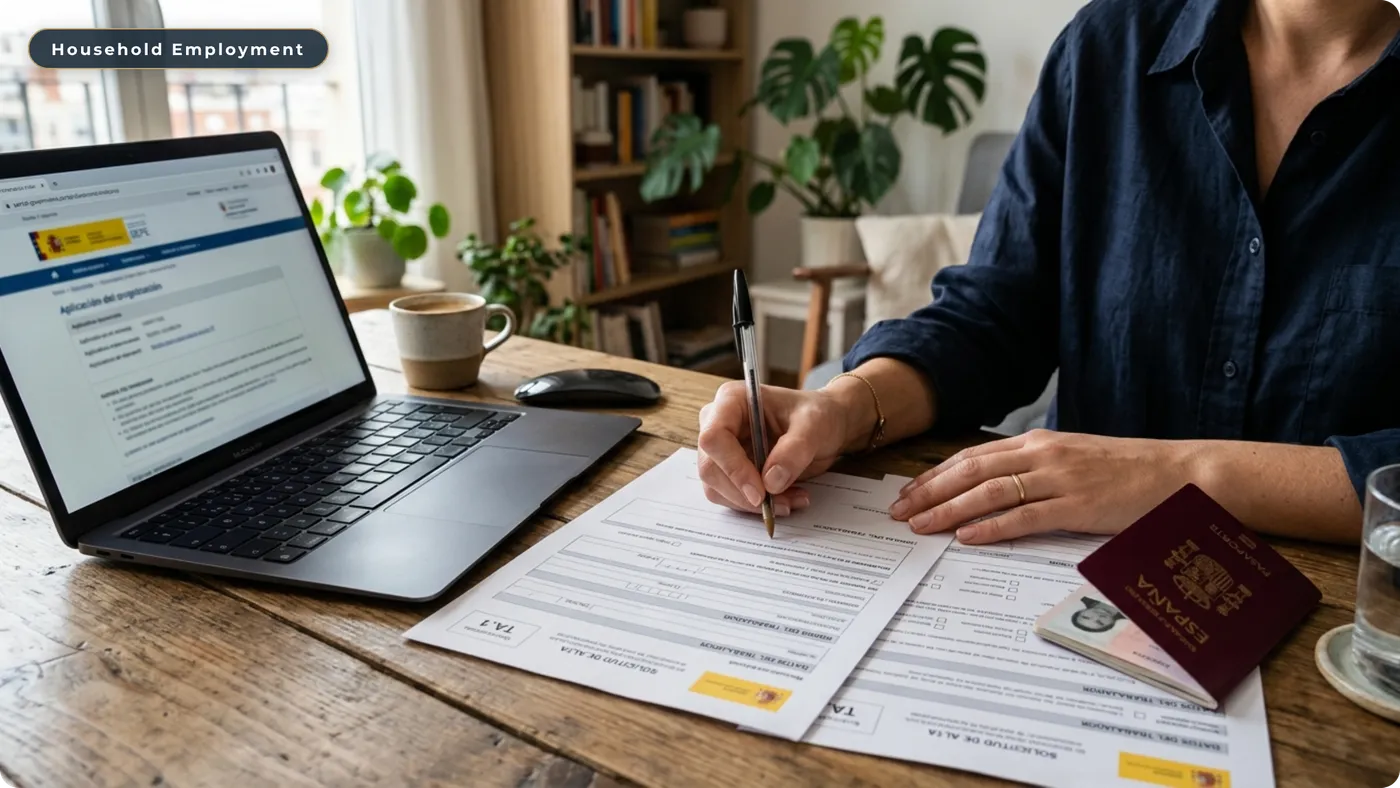
Imagine you own a home in Spain but spend most of the year in another country. You are not considered a tax resident here, yet you need to hire someone to look after your house, support a relative or help you around the home. And then the big question arises:
Can a non-tax-resident legally register a worker in Spain?
The answer is: yes, you can, but under very specific conditions.
What does it mean to be a non-tax-resident?
Tax residence determines which country you have to pay tax in.
In Spain, you are considered a tax resident if:
- You spend more than 183 days a year on Spanish territory.
- Or your main centre of economic or family interests is in Spain.
If you do not meet those criteria, you become a non-tax-resident. In that case, you are taxed in Spain only on the income or activities you have in the country (for example, a rented property, or a job here).
It is worth separating two things that are often confused: where you pay tax (your tax residence) is one matter; being able to act as an employer before Social Security (Seguridad Social) is quite another. Not being a tax resident in Spain does not stop you from hiring or registering a domestic worker; it simply adds a few extra formalities, as we will see below.
Can a non-resident be an employer in Spain?
Spanish law does allow a non-resident to act as the employer of a domestic or similar worker, provided certain requirements are met:
- Hold a valid NIE (Numero de Identidad de Extranjero, the foreigner's identity number).
- Register as an employer with Social Security (Seguridad Social).
- Have an address in Spain for official notifications.
- Set up a direct debit for the contributions from a SEPA-area account: a Spanish bank is not compulsory, since any SEPA-area IBAN is accepted (Regulation (EU) 260/2012).
One tax point is worth clarifying: in domestic employment the employer does not withhold income tax (IRPF) or report the payroll to the tax authorities (Hacienda). You would only have tax obligations in Spain if you receive other income in the country (for example, a rented property); obtaining the NIE/NIF, by contrast, is essential.
In addition, if you are resident outside the EU/EEA in a country with no mutual assistance agreement, the rules require you to appoint a fiscal representative in Spain (usually a lawyer, adviser or authorised person) who can answer to the tax authorities (Hacienda) and Social Security on your behalf. Residents in the EU/EEA are exempt from this obligation.
The NIE and the SEPA account, step by step
- Apply for the NIE at a Spanish consulate in your country of residence or, if you are in Spain, at an immigration office or police station. A representative with power of attorney can also handle it on your behalf.
- Designate an account with a SEPA-area IBAN for the direct debit of contributions: any bank in the area will do, and it need not be Spanish.
- Register the worker in the Special System for Domestic Employees within the General Social Security Scheme (Sistema Especial para Empleados de Hogar del Regimen General) before they start work, stating the salary, hours and the direct-debit account.
Registration with Social Security (Seguridad Social) is compulsory from the very first hour worked: there is no minimum number of hours or days below which you can do without it. Since 2023, moreover, the employer bears most of the contribution, and the person hired is entitled to unemployment benefit and to cover from the Wage Guarantee Fund (FOGASA).
How much does it cost to register a domestic worker in 2026?
The cost depends on the agreed salary, which can never be lower than the Spanish minimum wage (SMI). Royal Decree 126/2026 set the 2026 SMI at 1,221 €/month over 14 payments (17,094 €/year) or, equivalently, 1,424.50 €/month if prorated over 12 payments. For hourly work under the external regime, the minimum rate is 9.55 € per hour actually worked, an amount that already includes the proportional share of extra payments and holiday.
| Item | 2026 amount |
|---|---|
| Base salary, full-time (14 payments) | 1,221 €/month |
| Prorated salary (12 payments) | 1,424.50 €/month |
| Minimum hourly rate (external regime) | 9.55 €/hour |
| Minimum annual salary | 17,094 € |
| Total cost with employer's Social Security contributions | approx. 1,801 €/month |
Let's look at an example. If you hire a full-time worker on the SMI, you will pay 1,221 € in salary in each of the 14 payments plus the Social Security (Seguridad Social) contributions due from the employer. Adding the two together, the total cost is around 1,801 €/month. That contribution includes the Intergenerational Equity Mechanism (Mecanismo de Equidad Intergeneracional, MEI), which in 2026 is 0.90% of the base. Remember that the employer does not withhold income tax (IRPF), so the person hired receives their salary in full.
If you only need help for a few hours, the calculation is proportional. For example, 15 hours a week at 9.55 € comes to around 620 €/month in salary, to which the proportional contribution is added. Cutting the hours lowers the cost, but the duty to register does not disappear: contributions must be paid for short working weeks too.
The worker must also be authorised
Registering someone takes more than just meeting the requirements yourself: the person hired must be able to work legally in Spain. Here their nationality is decisive.
Workers from the European Union
Citizens of the EU, the EEA or Switzerland do not need a work permit. They only have to obtain their NIE and register with Social Security (Seguridad Social); the procedure is almost immediate.
Non-EU workers
If the person comes from outside the EU, they must hold an authorisation that allows them to work. The usual route in domestic employment is the residence permit through the arraigo sociolaboral route under the Spanish Immigration Regulation (Royal Decree 1155/2024, in force since 20 May 2025): it requires proof of two years' residence in Spain and a contract of at least 20 hours a week paid at no less than the SMI, with no prior complaint against an employer being necessary.
To start the process, a pre-contract with a suspensive clause is signed, which must provide for a working week of 20 hours or more, a minimum duration of three months and a salary equal to or above the SMI. In addition, throughout 2026 the extraordinary regularisation under Royal Decree 316/2026 remains open, with applications accepted until 30 June 2026.
An important nuance: in these procedures the employer is the family (the person doing the hiring), not the agency. Even if you delegate the administration to a third party, your name appears on the contract and on the registration as the party responsible in employment terms.
What if you don't meet those requirements?
If you cannot register as a direct employer, it does not mean you cannot hire help legally. There are alternatives:
- Hire through an agency or company that acts as the employer. You pay for the service and the company takes on the employment and tax obligations.
- Delegate to a fiscal representative who handles the whole process for you.
- Use specialist domestic-employee management services, which handle the Social Security registration, payroll and contributions.
And it is best not to improvise: having a worker on the job without Social Security (Seguridad Social) registration is a serious infringement. The Law on Infringements and Sanctions in the Social Order (Ley de Infracciones y Sanciones en el Orden Social, LISOS) provides for fines of between 3,750 € and 12,000 € for each unregistered worker, on top of payment of the back contributions plus a surcharge.
Employment and tax rules are strict. Hiring without meeting the requirements can lead to financial penalties and legal problems. So if you are in this situation, the most sensible thing is to seek specialist advice before taking the step.
And what if you have to end the contract?
It is worth knowing in advance how the relationship ends, because that has a cost too. Since 2022 the employer can no longer withdraw from the contract without giving a reason (the former desistimiento): termination must rest on a justified cause, be notified in writing and comes with compensation of 12 days' salary per year worked, up to a maximum of 6 months' pay. If the dismissal were ruled unfair, the compensation rises to 33 days per year, up to a maximum of 24 months' pay. In any case, on termination you must settle the final payment (finiquito), which includes the extra payments prorated by half-year and any holiday not taken.
In short, being a non-tax-resident is no obstacle to having a domestic worker fully in order: you simply add the NIE, a SEPA account and, in some cases, a fiscal representative. If you would rather not deal with the formalities, delegating to a specialist agency ensures that the registration, payroll and contributions are handled correctly from day one.
LOOKING FOR STAFF?
First profiles in under 3 hours
We select, interview and check references; you simply decide. One-off fee and a 6-month guarantee.
Frequently asked questions
- Do I need an NIE to register a domestic worker if I'm not a resident?
- Yes. The NIE is essential to act as an employer before Social Security (Seguridad Social) and to set up the direct debit of the monthly contributions. If you have no NIE, bank account or address in Spain, the legal alternative is to hire through an agency that acts as the employer or to delegate to a fiscal representative.
- Does a non-resident employer have to withhold income tax (IRPF) from their domestic worker?
- No. No private employer, resident in Spain or not, is required to withhold income tax (IRPF) from a domestic worker's pay. What is compulsory, from the very first hour worked, is registration and contributions with Social Security (Seguridad Social); the worker settles any IRPF themselves in their own tax return if they exceed the legal thresholds.
- How much does it cost to have a registered domestic worker in 2026?
- The cost starts from the sector's minimum wage: 1,221 €/month over 14 payments (equivalent to 1,424.50 €/month over 12 payments), that is 17,094 €/year for full-time work. To this you add the employer's contribution (around 23.60% of the base for common contingencies plus the employer's share of the MEI, 0.75%; the total MEI in 2026 is 0.90%). There is a general 20% reduction on the contribution, which can be increased depending on the case.
- What happens if I spend more than 183 days in Spain as the employer?
- If you exceed 183 days in a calendar year you become a tax resident in Spain and are taxed on your worldwide income, not just on income generated here. Your obligations as an employer do not change: registration and contributions with Social Security (Seguridad Social) are compulsory from the very first hour, whether you are a tax resident or not.