Do You Deduct Income Tax (IRPF) from a Housekeeper?
Private employers in Spain are not required to deduct income tax (IRPF) from a domestic worker's payslip, but the worker must still file a tax return if their earnings exceed certain thresholds. Here is the rule in force for 2026.

By Isabella Velletri, Founder of Maids & Co
Published on Updated on 5 min read
In short
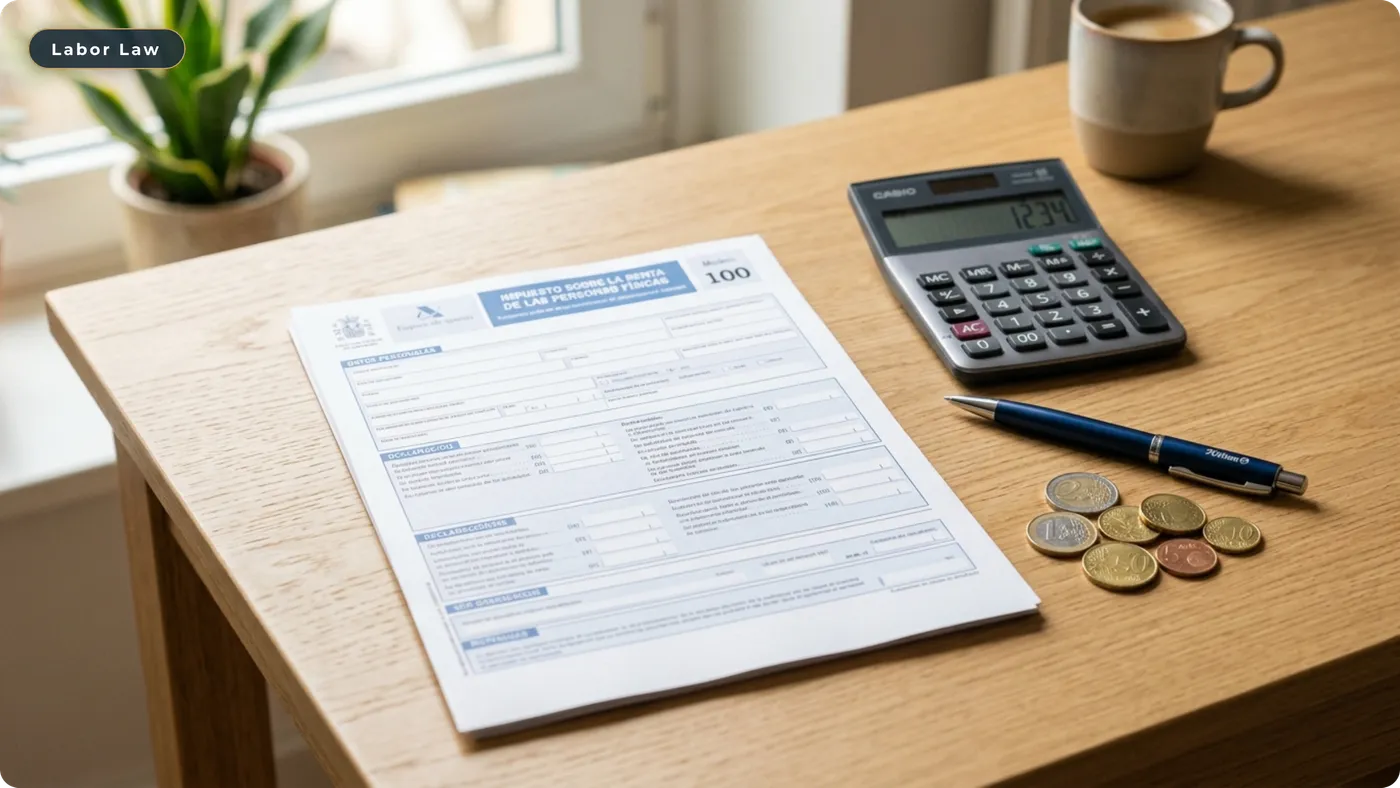
Hiring a domestic worker raises plenty of tax questions, both for the employing family and for the worker. One of the most common is: do you have to deduct income tax from the payslip? Below we explain the answer, with its legal basis, a worked example and practical recommendations, updated for 2026.
What does the law say about income tax in domestic employment?
Royal Decree 1620/2011, which governs the special employment relationship of domestic household service, does not require the employer to withhold income tax. In addition, private employers are not among the parties obliged to withhold tax or make payments on account that are listed in article 76 of the Spanish income tax regulations (Royal Decree 439/2007). The conclusion: a private individual who hires a domestic worker does not deduct income tax from the payslip.
This applies to every type of employment relationship between private individuals and domestic workers: live-in or live-out, part-time or full-time.
It is possible, if the worker asks for it, to agree a voluntary income tax deduction on the payslip so that they do not have to pay a lump sum when filing their return. This is optional and never compulsory for the employer.
So does the worker have to declare income tax?
Yes, in some cases. Even with no monthly deduction, the income received counts as earned income for tax purposes, so a domestic worker may be required to file a tax return when their earnings exceed the legal thresholds (article 96 of the Spanish Income Tax Act, Law 35/2006).
When is the worker required to file a return?
The general threshold depends on whether the worker has one or several payers (employers):
- With a single payer: they must file a return if they earn more than 22,000 €/year gross.
- With two or more payers: the threshold drops to 15,876 €/year gross, provided the total earned from the second payer onwards exceeds 1,500 €/year.
- If the total from the second payer onwards does not exceed 1,500 €/year, the 22,000 € threshold still applies.
| Worker's situation | Threshold for being required to file |
|---|---|
| Single payer (employer) | 22,000 €/year gross |
| Two or more payers, with the 2nd onwards totalling more than 1,500 €/year | 15,876 €/year gross |
| Two or more payers, but the 2nd onwards totalling 1,500 €/year or less | 22,000 €/year gross |
For reference, the minimum wage for domestic workers in 2026 works out at 17,094 €/year gross for full-time work (Royal Decree 126/2026). So a worker with a single employer paid around the Spanish minimum wage (SMI) usually stays below 22,000 € and would not be required to file on that basis; with two payers and a second job above 1,500 €, however, they would cross the 15,876 € threshold. You can see the breakdown in our guide to how much a domestic worker earns in Spain in 2026.
Worked example
A domestic worker is employed by two households over the course of the year:
- Household 1: 1,000 €/month, so 12,000 €/year
- Household 2: 400 €/month, so 4,800 €/year
- Total: 16,800 €/year
The second payer (4,800 €) exceeds the 1,500 €/year limit and the total is above 15,876 €, so the worker is required to file a tax return.
What happens if the worker does not file a return?
If they are required to file and fail to do so:
- They may receive a formal demand from the Spanish Tax Agency (Agencia Tributaria).
- They could face financial penalties and late-payment interest.
- They will not be able to claim refunds or deductions (for maternity, rent, large-family status, and so on).
Does the employer have any paperwork to file with the tax authorities?
No. The private employer:
- Does not make income tax deductions.
- Does not make payments on account of the tax.
- Does not have to file Form 111 (modelo 111) or issue withholding certificates.
Their obligations centre on registration and Social Security (Seguridad Social) contributions, which are compulsory from the very first hour worked. You can check the cost in our guide to how much Social Security costs for a domestic worker.
Can the employer deduct anything on their own tax return?
At national level, the employer cannot deduct either the salary or the contributions paid for their domestic worker. That said, some autonomous communities (such as the Community of Madrid, Comunidad de Madrid) do offer regional tax deductions for hiring household staff where certain conditions are met, so it is worth checking the rules of your particular region.
What must appear on a domestic worker's payslip?
Even though there is no income tax, the payslip must show the gross salary, the deduction for the worker's Social Security contribution, the net salary, and the date and signature. As an agency, we recommend issuing monthly payslips signed by both parties: they protect employer and worker alike in the event of any dispute. You will find the step-by-step process in our guide on how to draw up a payslip for a domestic worker, and we answer the common question of whether payslips are compulsory for domestic workers.
How to explain it to the worker
Workers often ask why no income tax is being deducted, or whether this means they are working off the books. The best approach is to explain it clearly:
You are legally employed and registered with Social Security. Your employer is not required by law to deduct income tax, but that does not change the fact that you, as the worker, may have to declare your income if it exceeds the annual thresholds.
This information has been checked against the Spanish Tax Agency (Agencia Tributaria) and the legislation in force (the Spanish Income Tax Act, Law 35/2006; Royal Decree 439/2007; and Royal Decree 1620/2011) for the 2026 tax year. If you would rather delegate the registrations, payslips and contributions, at Maids & Co we manage the entire employment cycle for your domestic worker: take a look at our prices and our domestic worker service page.
ALREADY HAVE AN EMPLOYEE?
Our labour team handles registration, the contract and payslips
Deregistration and the final settlement too, with labour legal advice: you don't have to deal with the paperwork.
Frequently asked questions
- Does a domestic worker have to file an income tax return?
- Yes, if they exceed the legal thresholds: more than 22,000 €/year gross with a single payer, or 15,876 €/year with two or more payers when the second payer onwards pays more than 1,500 €/year. It does not depend on whether income tax is deducted from the payslip, but on their total earnings.
- How much can a domestic worker earn without filing an income tax return?
- Up to 22,000 €/year gross if they work for a single employer. With two or more payers, the threshold drops to 15,876 €/year provided the total from the second payer onwards exceeds 1,500 €/year; if it does not, the 22,000 € threshold still applies.
- Does the employer have to deduct income tax from the domestic worker?
- No. A private employer is not required to deduct income tax (Royal Decree 1620/2011 and article 76 of the Spanish income tax regulations). A voluntary deduction can only be applied if the worker requests it.
- Who pays the income tax for a domestic worker?
- The worker themselves, through their own tax return when they are required to file one. The private employer does not pay income tax on their behalf or file Form 111 (modelo 111).
- Can you deduct a domestic worker's wages on your income tax return?
- At national level you cannot deduct either the wages or the contributions. However, some autonomous communities, such as the Community of Madrid (Comunidad de Madrid), offer regional deductions for hiring household staff where the conditions are met.