Domestic Worker Health & Safety in Spain: RD 893/2024
Since 14 November 2025, every household that employs a domestic worker in Spain must comply with Royal Decree 893/2024 on health and safety. Here is a step-by-step guide for 2026: risk assessment, free eFundae training, PPE and health surveillance.

By Isabella Velletri, Founder of Maids & Co
Published on Updated on 7 min read
In short
Royal Decree 893/2024 regulates occupational health and safety in domestic service for the first time and brings the obligations of the employing household into line, with adaptations for the home environment, with those of any other business. This guide explains, step by step, what the rules require and how to comply correctly in 2026, whether you are a household employer or you work in the home.
When did Royal Decree 893/2024 become mandatory?
Royal Decree 893/2024 of 10 September was published in the Official State Gazette (Boletin Oficial del Estado, BOE) on 11 September 2024 and came into force the following day. However, its two core obligations, the home risk assessment and the preventive measures, have been fully enforceable since 14 November 2025, six months after the National Institute for Occupational Safety and Health (Instituto Nacional de Seguridad y Salud en el Trabajo, INSST) made the free tool available on the Prevencion10 portal.
Important: the rules apply to ALL types of domestic employment, full-time or part-time, live-in or live-out, by the hour, with no minimum number of hours. If an employment relationship exists, the health and safety obligation applies from the very first hour.
The employer's obligations at a glance
| Obligation | What it involves | Official resource | Who pays |
|---|---|---|---|
| Risk assessment | Identify the risks in the home in writing | Free tool on Prevencion10 (INSST) | Employer |
| Information | Inform the worker of the risks and the measures | The risk assessment document | Employer |
| Health and safety training | A prevention course at the start of the relationship | 5-hour course on eFundae | Free (Fundae) |
| Equipment and PPE | Provide safe tools and suitable PPE | — | Employer |
| Health surveillance | Voluntary medical check-up | Spanish National Health System | Free (SNS) |
Each obligation is set out in detail below.
1. Carry out a risk assessment of the home
This is the first step. The assessment must identify the risks that may exist in the home, for example:
- Manual handling of loads (bags, buckets, boxes).
- Ladders, step stools and falls from height.
- Irritant or corrosive cleaning products.
- Machines or electrical appliances.
- Ergonomic risks from awkward postures or repetitive movements.
- Damp, heat or poor ventilation in certain areas.
- Risks specific to caring for people, cooking, gardening or night and live-in work.
The assessment must be in writing and the worker must receive a copy. You can generate it free of charge using the official tool on the Prevencion10 portal (INSST), which includes a dedicated section for Domestic Household Service (Servicio del Hogar Familiar) with guides and templates, or you can commission it from a private consultancy.
2. Apply the mandatory preventive measures
Once the risks have been identified, the employer must put in place measures that eliminate or reduce them. For example:
- Replace unstable ladders with safe models.
- Use less aggressive cleaning products.
- Avoid excessive loads by organising tasks.
- Improve lighting or ventilation where necessary.
- Ensure that cables, sockets and appliances are in good condition.
These measures must be explained to the worker clearly and kept up to date whenever the tasks or the conditions in the home change.
3. Work equipment and PPE: what the employer must provide
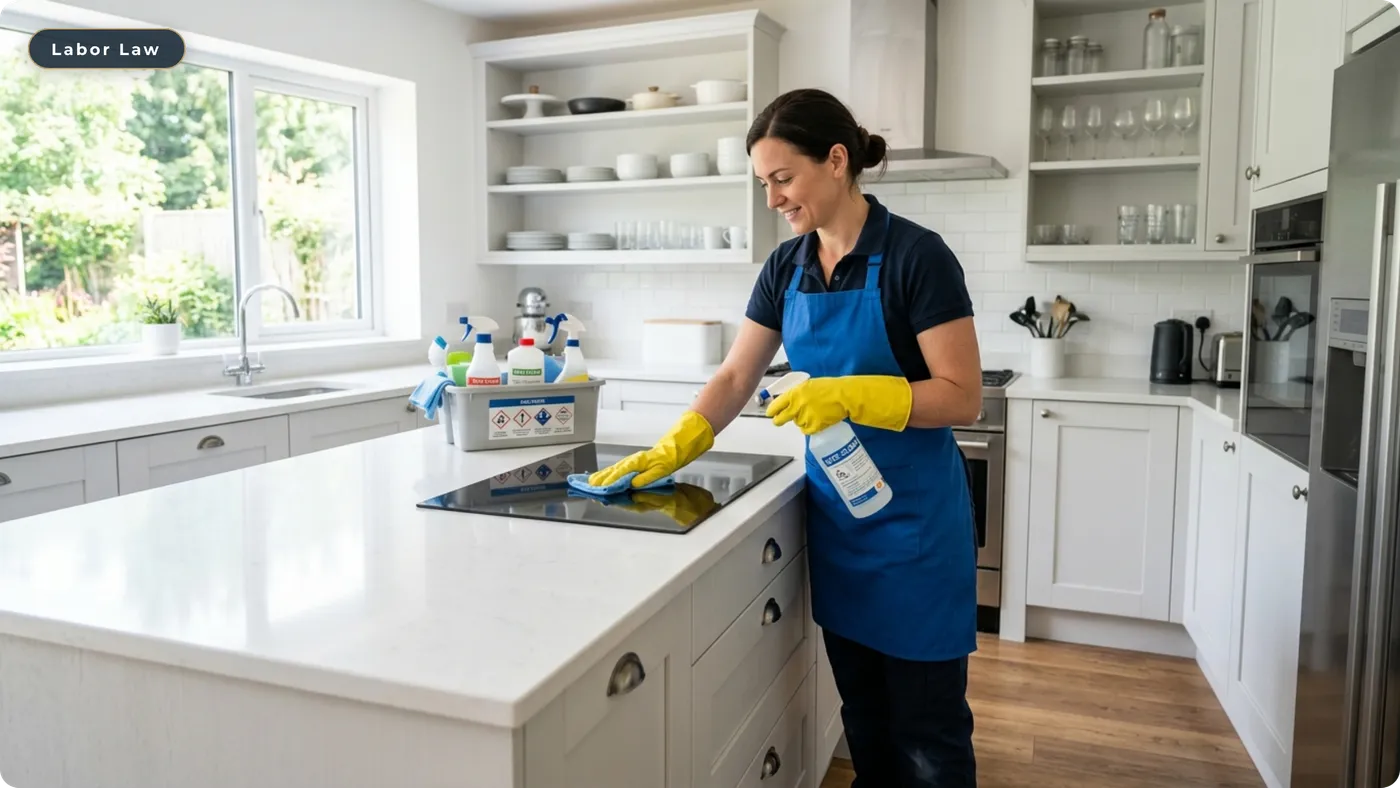
Royal Decree 893/2024 requires the employer to provide safe work equipment (for example, a vacuum cleaner in good working order, ergonomic tools or safe ladders) and the personal protective equipment (PPE) needed according to the assessment:
- Protective gloves.
- Masks for certain chemical products.
- Protective goggles where appropriate.
- Non-slip footwear.
The worker should not pay anything: the cost of work equipment and PPE is always the employer's responsibility.
4. Mandatory health and safety training (free on eFundae)
Since May 2026, the prevention training has been available and is enforceable. Fundae offers, free of charge, the online course 'Risk prevention in domestic household service' (Prevencion de riesgos en el ambito del servicio del hogar familiar), a 5-hour basic-level course available on the eFundae platform (efundae.es) and through the domestic employment area of the website of the Ministry of Labour and Social Economy (Ministerio de Trabajo y Economia Social). The self-assessment and certification system is governed by the Resolution of 8 May 2026 of the State Public Employment Service (SEPE) (BOE of 15 May 2026).
Key features of the training:
- It is free for the worker.
- It is delivered at the start of the employment relationship.
- It is taken only once, even if the worker provides services for several employers.
- It covers basic concepts and the risks of specific tasks (cleaning, cooking, caring for people, driving, gardening, night and live-in work).
- On passing at least 75% of the progress checks, the worker obtains a certificate of participation; if they also pass the assessment, a certificate of achievement.
You can find every official tool in detail — Prevencion10, the free Fundae course, the INSST Technical Guide and the violence-and-harassment protocol — in our article on the new health and safety tools for domestic workers in Spain.
5. Inform the worker
The employer must provide clear, easy-to-understand information, specific to the home where the work takes place, about:
- The risks identified in the home.
- The safe way to carry out each task.
- The correct use of equipment and products.
- The preventive measures adopted.
- The procedures to follow in an emergency.
6. Facilitate health surveillance
The worker is entitled to health surveillance, which is voluntary, it requires their consent, and free. It is provided by the Spanish National Health System (Sistema Nacional de Salud, SNS). It includes a medical check-up appropriate to the risks identified in the assessment, carried out at least every three years, unless a medical decision sets a more frequent interval or the working conditions change. The check-up may be carried out only once, even if the worker provides services for several employers.
Penalties for non-compliance
Failing to carry out the risk assessment, failing to inform or train the worker, or failing to facilitate health surveillance are serious infringements of health and safety law under the Spanish Law on Infringements and Penalties in the Social Order (Ley sobre Infracciones y Sanciones en el Orden Social, LISOS, Royal Legislative Decree 5/2000). Fines for a serious infringement range from 2,451 € to 49,180 € and may be aggravated to a very serious infringement where there is a serious and imminent risk to the worker.
| Classification | Minimum band | Medium band | Maximum band |
|---|---|---|---|
| Minor | 45 to 485 € | 486 to 975 € | 976 to 2,450 € |
| Serious | 2,451 to 9,830 € | 9,831 to 24,585 € | 24,586 to 49,180 € |
| Very serious | 49,181 to 196,745 € | 196,746 to 491,865 € | 491,866 to 983,736 € |
These health and safety fines are separate from the penalties for failing to register the worker with the Social Security (Seguridad Social), which is a distinct infringement. If you have questions about registration, see our guide to registering a domestic worker with the Social Security.
Checklist to comply with Royal Decree 893/2024
- Carry out the home risk assessment (free on Prevencion10).
- Give the worker a copy of the assessment.
- Apply the preventive measures identified.
- Provide safe work equipment and the necessary PPE.
- Arrange the free health and safety training through eFundae.
- Inform the worker about risks and safe procedures, specific to the home.
- Offer the voluntary, free health surveillance provided by the SNS.
- Ensure a working environment free from harassment and violence.
Royal Decree 893/2024 marks a decisive step in the professionalisation of domestic employment. Complying with it is straightforward if you follow clear steps: assess, inform, train and provide safe conditions.
How Maids & Co can help
At Maids & Co we handle compliance with Royal Decree 893/2024 on a turnkey basis: we help you with the risk assessment, with informing and training the worker, and with all the employment administration of domestic work. See our prices and our guides to hiring a housekeeper or a nanny with full legal guarantees. If you want to go deeper, we also explain how much the Social Security for a domestic worker costs and how to prepare their payslip.
ALREADY HAVE AN EMPLOYEE?
Our labour team handles registration, the contract and payslips
Deregistration and the final settlement too, with labour legal advice: you don't have to deal with the paperwork.
Frequently asked questions
- Is health and safety prevention mandatory for domestic workers?
- Yes. Royal Decree 893/2024 requires every employing household to apply occupational health and safety with its domestic worker, regardless of the hours or the arrangement (live-in, live-out or by the hour). This includes assessing the risks in the home, informing and training the worker, supplying PPE and facilitating health surveillance.
- Since when has the risk assessment been mandatory in domestic employment?
- Since 14 November 2025. Although Royal Decree 893/2024 came into force in September 2024, the risk assessment and the preventive measures have been fully enforceable since that date, six months after the INSST published the free tool on the Prevencion10 portal.
- Who pays for the risk assessment and the PPE of a domestic worker?
- The employer. The cost of work equipment and personal protective equipment (PPE) always falls to the employer; the worker should not pay anything. The risk assessment can be done free of charge using the official tool on the Prevencion10 portal.
- Is health and safety training for domestic workers free?
- Yes, it is free. Since May 2026, Fundae has offered the online course 'Risk prevention in domestic household service', a 5-hour basic-level course on the eFundae platform. It is taken only once even if the worker has several employers, and it includes certification.
- What are the penalties for not complying with Royal Decree 893/2024?
- Failing to carry out the risk assessment or to inform or train the worker is a serious health and safety infringement, with fines from 2,451 € to 49,180 € under the LISOS scale. It may be aggravated to a very serious infringement if there is a serious and imminent risk.
- What is Prevencion10 and what is it for in domestic employment?
- Prevencion10 is the free public portal run by the INSST that lets the household employer generate the home risk assessment in writing. It has a dedicated section for Domestic Household Service, with guides, templates and resources to comply with Royal Decree 893/2024.