Domestic Worker Contract Template: How to Fill It In
Learn how to fill in a domestic worker contract in Spain step by step in 2026: party details, working hours, the minimum wage (SMI), the trial period and Social Security registration.

By Isabella Velletri, Founder of Maids & Co
Published on Updated on 6 min read
In short

Filling in a contract template for a domestic worker is an important step for any employer. It is essential to make sure that both parties understand the terms of the working relationship. When completing a contract of this kind, you should include all the necessary information: the job description, the pay details, the employee's rights and obligations and any other relevant information. It is also important to ensure that the agreement is legally binding and that both parties understand its terms.
As the employer, you can offer a domestic worker either a temporary or a permanent contract. You can download both types of template below:
How to complete a domestic worker's employment contract template
- Employer's details — Include the head of the family household, meaning the person who lives at the place where the services are provided, together with the relevant country and municipality codes.
- Contribution account details — The number that identifies the head of the family household to the Social Security (Seguridad Social). If you do not have one, you can apply for it through the Social Security electronic office (sede electrónica).
- Worker's details — The details relating to the employee. The country, municipality and qualification codes can be checked in the official lists.
- Employment contract clauses:
Clause 1: The worker provides services as a domestic worker, within the professional group of household employees. State the address where the work will be carried out.
Clause 2: State the contract type and duration (permanent or temporary). Temporary contracts must specify the reason for the temporary arrangement and the expected end date.
Clause 3: Specify whether the engagement is full-time (40 hours per week) or part-time. Record the hours worked and describe the working schedule.
Clause 4: State the start date and the length of the trial period, which cannot exceed two months.
Clause 5: The worker's salary, which can never be below the Spanish minimum wage (SMI) — 1,424.50 € across 12 payments or 1,221 € across 14 payments in 2026, equivalent to 17,094 € per year — or the proportional part for part-time hours. For live-out workers paid by the hour, the minimum wage is 9.55 € per hour actually worked.
Clause 6: Holiday entitlement cannot be less than 30 calendar days.
Clause 7: There is no collective bargaining agreement for domestic workers.
Once you have filled in the basic details above, then for:
- A permanent contract: set the type of permanent contract for household service staff and define the type of working hours, any on-call hours (horas de presencia), overnight stays and any salary benefits paid in kind. Finally, both parties sign the contract.
- A temporary contract: set the type of temporary contract for household service staff and define the specific clauses governing the temporary arrangement, along with any on-call hours (horas de presencia), overnight stays and any salary benefits paid in kind. Finally, both parties sign the contract.
Social Security registration: compulsory from the very first hour
Even before the worker starts, the head of the household must register her with the Special System for Household Employees of the Social Security (Sistema Especial para Empleados de Hogar). This obligation applies from the very first hour worked, whether it is full-time or just a few hours a week: there is no minimum number of hours or days that exempts you from registration. The contributions are payable by the employer (with a small part deducted from the worker) and include the Intergenerational Equity Mechanism (Mecanismo de Equidad Intergeneracional, MEI), set at 0.90% for 2026.
Personal income tax (IRPF), by contrast, is not a compulsory withholding in this working relationship: it is only applied if both parties agree to it. Failing to register the worker is a serious offence: under the LISOS (the Spanish law on labour offences and penalties), fines range from 3,750 € to 12,000 € per worker, on top of paying the unpaid contributions. That is why registration is the first step, even before handing over the signed contract.
What hiring really costs: a worked example
The salary can never be below the SMI, but the cost to the family is not limited to the wage: you also have to add the social security contributions. For a full-time post paid at the SMI, the approximate breakdown for 2026 is as follows:
| Item | Monthly amount (full-time at the SMI) |
|---|---|
| Gross salary (equivalent across 12 payments) | 1,424.50 € |
| Employer's contributions (including MEI at 0.90%) | ≈ 376 € |
| Approximate total cost to the family | ≈ 1,801 € |
Workers paid by the hour (live-out arrangement)
If you hire by the hour, the minimum is 9.55 € per hour actually worked. For example, a live-out worker who works 20 hours a week builds up around 86 hours a month (20 × 4.33 weeks), which works out at a gross salary of roughly 827 € per month, to which you must also add the proportional contribution. The hourly figure already includes the proportional part of the extra payments and holiday, so these are not paid separately.
Hiring a foreign domestic worker
If the person you are going to hire is not a Spanish national, it is worth distinguishing their situation before signing the contract.
EU citizens
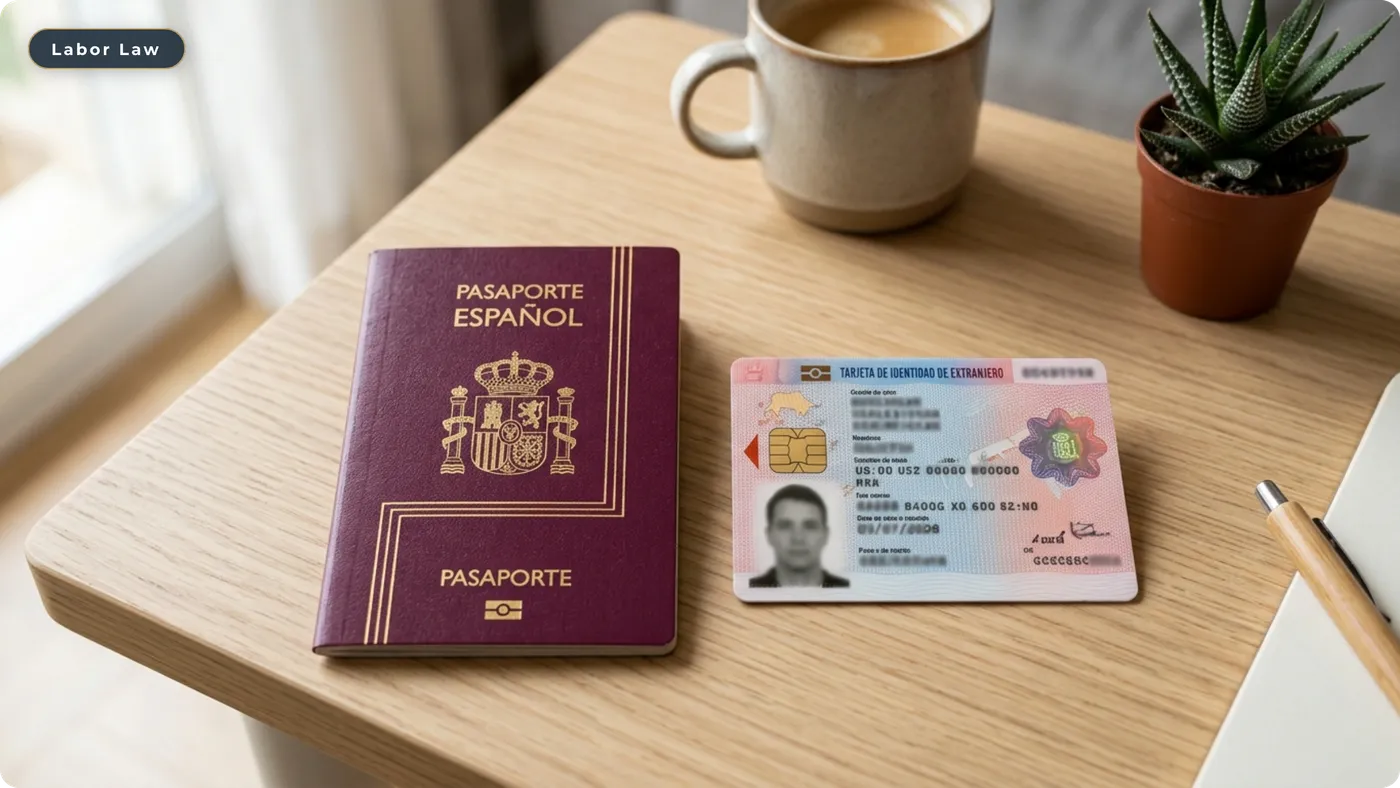
Workers from the EU/EEA do not need a work permit. They simply need their NIE (foreigner identity number) and to be registered with the Social Security like any other domestic worker.
Non-EU citizens
For people from outside the EU, the usual route is the residence permit through the arraigo sociolaboral (social and employment roots) route under the Spanish Immigration Regulations (Royal Decree 1155/2024, in force since 20 May 2025). It requires proof of two years' residence in Spain and one or more contracts of at least 20 hours a week paid at least at the SMI, without any need to first report the irregular situation. In these cases, it is the family who acts as the employer, not the agency.
To start the process, an arraigo pre-contract is usually signed: a job offer of at least 20 hours a week, with a minimum duration of three months, a salary equal to or above the SMI and a suspensive clause making the start of work conditional on the permit being granted. In addition, Royal Decree 316/2026 has opened an extraordinary regularisation process, applications for which can be submitted until 30 June 2026.
Ending the contract: termination for cause, dismissal and final settlement
The special employment relationship in the family household has its own rules for termination. Since 2022 the head of the household can no longer withdraw at will (the former desistimiento): the contract may be ended for a justified cause, notified in writing, with compensation of 12 days' salary per year worked, up to a maximum of six months' pay. If the termination is found to be unfair, the compensation rises to 33 days per year, capped at 24 months' pay.
When the contract ends, whatever the reason, you must provide the final settlement (finiquito), which includes the proportional part of the extra payments — apportioned by six-month period — and any holiday not taken. It is advisable to put this in writing and give the worker a copy.
If you need help, do get in touch. We offer a domestic-staff hiring service: we take care of the contract, Social Security registration and any other arrangements you may need.
ALREADY HAVE AN EMPLOYEE?
Our labour team handles registration, the contract and payslips
Deregistration and the final settlement too, with labour legal advice: you don't have to deal with the paperwork.
Frequently asked questions
- Can a domestic worker's contract be temporary or permanent?
- Both. It can be permanent or temporary; a temporary contract must state the reason for the temporary arrangement and the expected end date.
- How long is the trial period?
- The trial period cannot exceed two months.
- What salary must appear in the contract in 2026?
- Never below the SMI: 1,221 € across 14 payments or 1,424.50 € across 12 payments (or the proportional part for part-time hours) in 2026.
- Is a written contract compulsory?
- Yes. A written contract and Social Security registration are compulsory from day one, including for part-time or hourly work.