Domestic worker payslip: is it required by law?
Yes - Spanish law requires you to give your domestic worker a payslip. Here is what it must include, a worked 2026 minimum-wage example, special cases and the fines for getting it wrong.

By Isabella Velletri, Founder of Maids & Co
Published on Updated on 8 min read
In short
Yes - giving your domestic worker a payslip is essential, and it is exactly what Spanish law requires. Many people who take on household staff are unsure whether a payslip is genuinely compulsory in Spain. Getting this right matters: it keeps you on the right side of the law and ensures a fair, transparent working relationship.
To understand why a payslip is compulsory, it helps to look at the legal framework for the sector. Law 27/2011 (Ley 27/2011) brought domestic workers into the Special System of the General Social Security Regime (Sistema Especial del Regimen General de la Seguridad Social) from 1 January 2012, while Royal Decree 1620/2011 (Real Decreto 1620/2011) governs this special employment relationship and brings domestic workers' rights into line with those of other employees. More recently, Royal Decree-Law 16/2022 (Real Decreto-ley 16/2022) strengthened these guarantees, requiring a written contract and the full application of the Labour Inspectorate (Inspeccion de Trabajo) to domestic employment.
Article 8.6 of Royal Decree 1620/2011 states that wages must be documented by issuing an individual, itemised receipt of payment, either in the form agreed between the parties or in accordance with article 29.1 of the Workers' Statute (Estatuto de los Trabajadores). That article, in turn, requires wages to be documented through an individual, itemised receipt that follows the template approved by the Ministry of Labour and Social Economy (Ministerio de Trabajo y Economia Social), or another clear, detailed format agreed by collective bargaining agreement or between the employer and the workers' representatives.
What a domestic worker's payslip must include
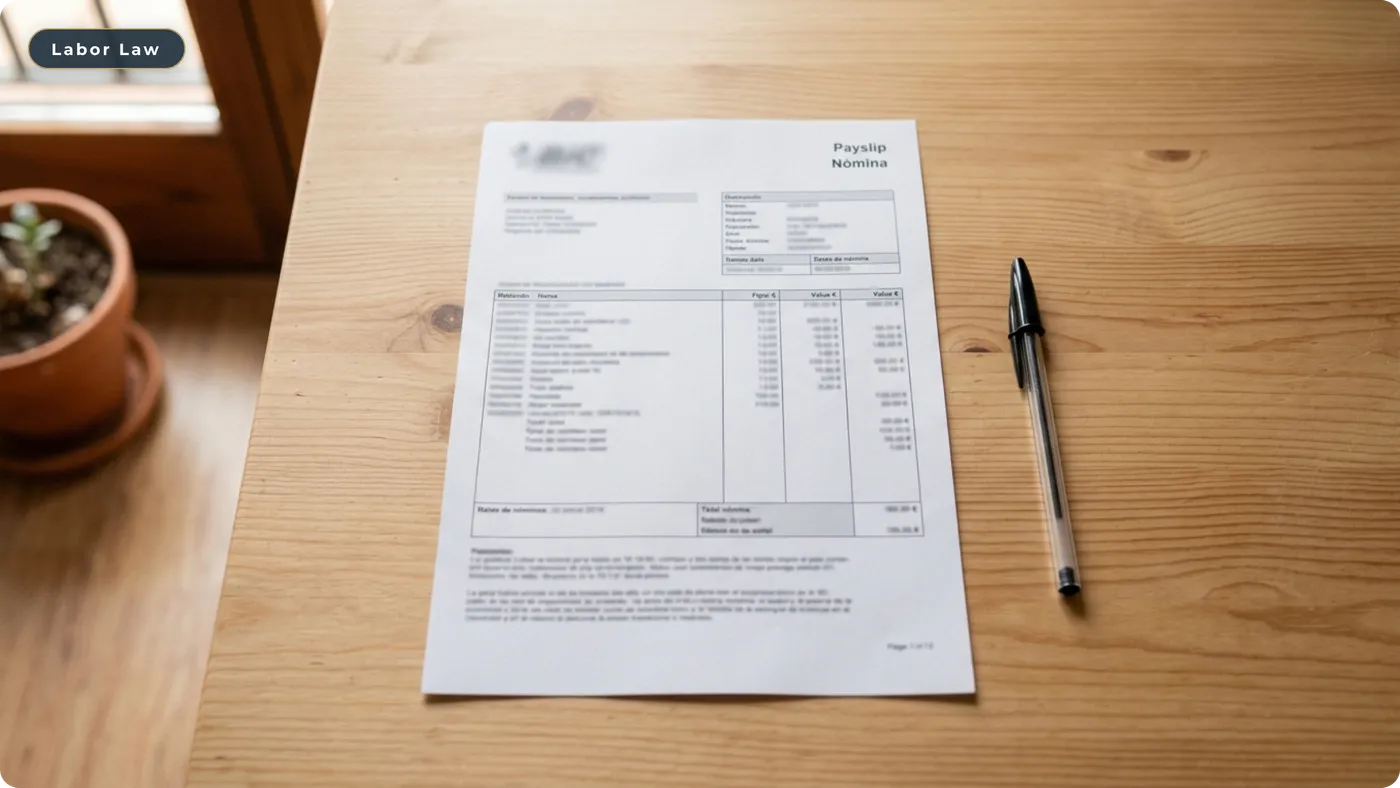
A domestic worker's payslip follows the same structure as any other wage receipt, simply adapted to this special employment relationship. A bank transfer record is not enough on its own: the document must make it possible to check how the worker's pay has been calculated. These are the sections that must always appear:
- Header: the employer's details (name, DNI/NIE and address) and the worker's details (name, DNI/NIE, Social Security affiliation number and contribution group).
- Pay period: the month the payment relates to and the number of days worked.
- Earnings: base salary, any supplements, the pro-rata share of the extra payments (pagas extraordinarias, where these are paid on a pro-rata basis) and, where applicable, payment in kind.
- Deductions: the worker's Social Security (Seguridad Social) contribution and income tax (IRPF) withholding, where this has been agreed.
- Net pay: the take-home amount the worker actually receives.
- Contribution bases, place of issue, date and the signatures of both parties.
Sample payslip using the 2026 minimum wage
For 2026, Royal Decree 126/2026 sets the minimum wage for a domestic worker - the Spanish minimum wage (SMI) - at 1,221 €/month across 14 payments (1,424.50 €/month if the extra payments are spread across 12 monthly instalments), 17,094 €/year, or 9.55 €/hour actually worked. Registration with Social Security (Seguridad Social) is compulsory from the very first hour of work. Here is what an indicative full-time payslip would look like, with the extra payments spread across the year:
| Item | Amount (indicative) |
|---|---|
| Base salary (12 payments, pro-rata extras included) | 1,424.50 € |
| Total earnings (gross) | 1,424.50 € |
| Worker's Social Security contribution | −91 € |
| Income tax (IRPF) withholding (not compulsory) | 0 € |
| Net pay (take-home) | ≈ 1,333 € |
| Contributions payable by the employing household | +377 € |
| Total monthly cost to the household | ≈ 1,801 € |
The figure that really matters for the household is not the gross salary but the total cost: around 1,801 €/month for a full-time worker on the minimum wage, once you add the contributions payable by the employer. The worker, meanwhile, receives the net amount after her Social Security (Seguridad Social) contribution has been deducted. Two points are worth remembering: income tax (IRPF) withholding is not compulsory in domestic employment (it can be agreed voluntarily, but the household is not obliged to apply it), and the difference between 1,221 € across 14 payments and 1,424.50 € across 12 payments is purely a matter of how the money is spread out - the annual total, 17,094 €, is the same either way.
The benefits of issuing a payslip
Issuing a payslip to your domestic worker brings real benefits. The document is not only proof of payment; it also brings transparency and clarity to the working relationship. It can also prove decisive in situations such as applying for a loan or accessing certain benefits.
For the worker, the payslip is evidence of her income and length of service: she will need it to apply for a mortgage or a loan, rent a home, claim benefits or prove her employment status in immigration matters. For the employing family, it is the guarantee that they are complying with the law and their best defence against any future claim: before the Labour Inspectorate (Inspeccion de Trabajo) or a court, a signed receipt proves what was paid and when. Without a payslip, in the event of a dispute the worker's version of events is generally presumed to be correct.
Special cases in domestic employment
Hourly or live-out workers
The obligation to provide a payslip does not depend on the number of hours worked. Whether your worker is full-time or comes in for a few hours a week, you must register her with Social Security (Seguridad Social) from the first hour and document every payment. For live-out workers paid by the hour, the reference rate is 9.55 €/hour actually worked, an amount that already includes the proportional share of extra payments and holiday pay.
Workers employed by several households
The same worker can provide services in several homes. In that case, each family is a separate employer: each one must register her for its own block of hours, pay contributions for its share and issue its own payslip. There is no such thing as a joint payslip shared between households.
Payment in kind: board and lodging
When the worker lives in the household (a live-in arrangement) or receives meals, that board and lodging counts as payment in kind and must appear, with a value attached, on the payslip. The law sets two limits: payment in kind may not exceed 30% of the total salary, nor may it reduce the full cash amount of the Spanish minimum wage (SMI). In other words, the worker must always receive the SMI in cash, with anything in kind added on top.
The final settlement when the relationship ends
The duty to document wages extends to the end of the contract. The final settlement (finiquito) must cover any outstanding amounts (the salary for the days worked and the proportional share of the extra payments, calculated per six-month period). On top of this, depending on the reason for termination, comes the corresponding severance: 12 days' salary per year worked where the employer ends the contract for a justified cause notified in writing (the former desistimiento; capped at 6 months' pay), or 33 days per year where a dismissal is ruled unfair (capped at 24 months' pay). Keeping every payslip makes it easy to calculate these amounts without any argument.
Foreign workers: payslips and regularisation
When you hire a foreign worker, it is the family (not the agency) that is the employer in every respect. If she is an EU citizen, she only needs an NIE and registration with Social Security (Seguridad Social). If she is from outside the EU, the usual route is a residence permit through the arraigo sociolaboral route under the Immigration Regulation (Royal Decree 1155/2024, in force since 20 May 2025): it requires two years of residence in Spain and a contract of at least 20 hours a week paying at or above the SMI, with no prior complaint needed. This is normally arranged through a preliminary contract of at least 20 hours a week, a minimum duration of 3 months and a salary no lower than the SMI, subject to a suspensive clause. In addition, Royal Decree 316/2026 opened an extraordinary regularisation process for which applications can be submitted until 30 June 2026. In all of these procedures, the contract, the Social Security registration and the payslips are the proof that the employment relationship is genuine.
Penalties for non-compliance
Failing to meet these obligations can lead to financial penalties for the employer, the size of which depends on the seriousness of the offence under the Law on Offences and Penalties in the Social Order (Ley sobre Infracciones y Sanciones en el Orden Social, LISOS):
- Minor offence: failing to issue the wage receipt, or not following the required template, is penalised with fines of 70 € to 750 €.
- Serious offence: failing to record on the payslip the amounts actually paid to the worker carries fines of 751 € to 7,500 €.
These fines should not be confused with the penalties for keeping a worker without registering her. Failing to document wages is the payslip offence; but having someone work without Social Security (Seguridad Social) registration is a separate and far more serious offence, penalised under the LISOS with fines of between 3,750 € and 12,000 € per worker, on top of the obligation to pay the unpaid contributions. This is why the payslip, the contract and the Social Security registration form a single package of obligations that is best met from day one.
Issuing a payslip does not only benefit the worker; it also protects the employer by providing clear evidence of every financial transaction. Ultimately, building a working relationship based on honesty and respect makes for a stable, harmonious arrangement on both sides.
To make life easier, Maids & Co offers a downloadable domestic worker payslip template. And if you would rather not prepare a payslip every month yourself, we offer a payroll preparation service that can be arranged separately. Get in touch and we will help you with whatever you need.
ALREADY HAVE AN EMPLOYEE?
Our labour team handles registration, the contract and payslips
Deregistration and the final settlement too, with labour legal advice: you don't have to deal with the paperwork.
Frequently asked questions
- What details must a domestic worker's payslip include?
- The payslip must show the employer's and the worker's details, the pay period and days worked, the base salary with the pro-rata share of the extra payments, the worker's Social Security (Seguridad Social) deduction and the net pay, signed by both parties. It is best to use the official Ministry template or a clear receipt itemised by category. A receipt without that breakdown does not count as valid proof of payment.
- How much is deducted from a domestic worker's payslip?
- Around 6.4% of her contribution base is deducted from the worker: 4.70% for common contingencies, 1.55% for unemployment and 0.15% for the MEI (which totals 0.90% in 2026). On a base of 1,424.50 €, that comes to about 91 €, as in the sample payslip above. The rest of the contribution is paid by the employer, who is solely responsible for remitting the full amount to Social Security (Seguridad Social). Income tax (IRPF) withholding is not compulsory under this scheme unless both parties agree to it.
- Do I have to register the worker with Social Security before issuing a payslip?
- Yes. Registration with Social Security (Seguridad Social) is compulsory from the very first hour of work, even if the worker only does a few hours a week. It is a separate step that comes before issuing the payslip: failing to register is a serious offence that can be fined between 3,750 € and 12,000 €, on top of having to pay the unpaid contributions plus surcharges.
- What is the minimum wage for a domestic worker in 2026?
- In 2026, the minimum wage for a full-time domestic worker is 1,221 €/month across 14 payments, or 1,424.50 €/month across 12 payments with the extras spread out, which works out at 17,094 €/year. For live-out workers paid by the hour, the minimum is 9.55 €/hour actually worked. A payslip can never show an amount lower than these figures.